.jpg)


31st week CCM 2026. Standards. Carbon credits for renewable energy and forests in Ethiopia; GHG Protocol and ISO join forces; IFRS digital taxonomy; SBCE, Atlantic Forest expands; COP31 startups
Monday, 03 August 2026.
31st Week Carbon Credit Markets in 2026.
If you’d like, read the article while listening to a Carbon Credit Markets song.
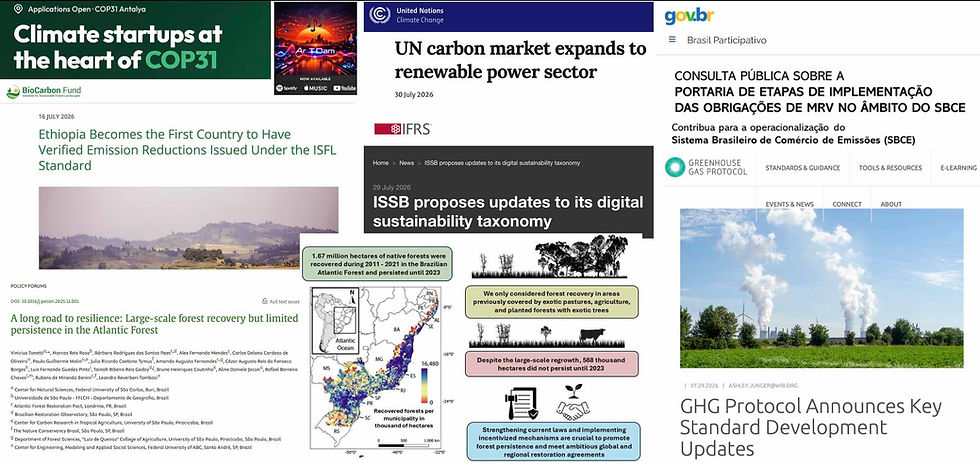
Carbon credits are advancing with the inclusion of renewable energy under Article 6.4 - expanding the UN market and strengthening global goals - while Ethiopia has recorded verified reductions for the first time under the World Bank’s Initiative for Sustainable Forest Landscapes (ISFL) standard, totaling 14.9 million tCO₂e and marking a significant step toward high-integrity climate finance.
Other highlights, the GHG Protocol and ISO are proposing a unified global standard for carbon accounting - reinforcing governance, transparency, and interoperability - while the ISSB has launched a public consultation on updating the IFRS digital taxonomy, aiming to improve the representation of emissions and market instruments and thereby enhance the accuracy and utility of environmental disclosures for investors.
Briefs and Opportunities, the Brazilian government has opened a public consultation on MRV obligations within the SBCE, detailing implementation stages and the gradual inclusion of sectors, with submissions accepted until August 28, 2026; in the Atlantic Forest, a recent study reveals a gain of 1.67 million hectares of native vegetation between 2011 and 2021, highlighting both the progress made and the challenges involved in large-scale restoration; and, looking ahead to COP31, Turkey has announced a "Startup Zone" dedicated to climate innovation - reinforcing the role of entrepreneurs and investors - a move that aligns with the "Agrizone" launched by Brazil at COP30.
In addition to a list of relevant events.
Carbon Credits
Renewable energy included in the carbon credit market under Article 6.4
Published on July 30, 2026, the UNFCCC statement informs that the Article 6.4 Supervisory Body has adopted a new methodology that allows grid-connected renewable energy projects to seek carbon credits under the Paris Agreement Carbon Credit Mechanism. Renewable energy is growing rapidly, but many countries still need support to make their projects viable. The decision therefore represents progress in expanding the UN carbon credit market, supporting developing countries and contributing to global goals such as tripling renewable capacity by 2030, doubling energy efficiency and keeping 1.5°C within reach. The statement highlights that the next methodologies under development cover the transport, waste and agriculture sectors, and that by including renewable energy in addition to the existing methodologies for landfill biogas methane and nitrous oxide from nitric acid production, the set of projects with potential for carbon credits under the Paris Agreement is further expanded. Both this new methodology on renewable energy and another on energy efficiency for household cooking are in public hearing until mid-August 2026 and will return for consideration at the next meeting of the Supervisory Body in October.
Ethiopia issues verified carbon credits for the first time under the ISFL standard
A statement released on July 16 by the BioCarbon Fund – Initiative for Sustainable Forest Landscapes (ISFL) - a World Bank program dedicated to structuring high-integrity jurisdictional carbon markets - announces that Ethiopia has become the first country to have verified emission reductions (VERs) issued under the ISFL standard. A total of 14.9 million tCO₂e were registered for the first monitoring period of the Oromia Forested Landscape Program. Of these, 12.4 million are available for transactions, all recorded in the Carbon Asset Tracking System (CATS). This milestone reflects over a decade of sustained effort by the national government, the Oromia region, development partners, and hundreds of thousands of forest-dependent communities, consolidating the technical and social foundations for robust climate outcomes and new financing opportunities for the country.
Others Highlights
GHG Protocol and ISO move toward a unified global standard for carbon accounting
On July 29, 2026, the GHG Protocol - a global benchmark for emissions accounting established by the WRI and WBCSD - announced updates aimed at strengthening the governance and reliability of carbon accounting. These include a joint decision with ISO to unify their corporate standards into a single, harmonized global standard. The announcement also highlights the publication of results from the public consultation on Scope 2, as well as progress on the AMI standard - which addresses market actions and instruments such as carbon credits - now synchronized with the Scope 2 review process. Collectively, these measures reinforce the drive for transparency, interoperability, and credibility in corporate emissions reporting, solidifying the central role of carbon accounting in the climate transition.
ISSB proposes digital update to strengthen disclosures on emissions and market-based instruments
On July 29, 2026, the ISSB - the IFRS Foundation body responsible for global sustainability disclosure standards - published the IFRS Sustainability Disclosure Taxonomy - Proposed Update 1: Amendments to Greenhouse Gas Emissions Disclosures. This proposal updates its digital taxonomy to reflect amendments made in December 2025 to the IFRS S2 standard. It enhances how companies digitally represent greenhouse gas emissions information thereby ensuring greater accuracy, comparability, and interoperability across reports. According to the ISSB, the update does not create new requirements but strengthens the transparency and usefulness of information for investors. The public consultation remains open until September 28, 2026, reinforcing the entity's commitment to the standardization, clarity, and digital accessibility of environmental disclosures.
Briefs & Opportunities
Brazilian government has opened a public consultation on MRV (monitoring, reporting, and verification) obligations within the framework of the Brazilian Emissions Trading System (SBCE). The draft ordinance outlines the implementation stages and is accompanied by a Regulatory Impact Analysis (RIA). The proposal envisions the gradual inclusion of economic sectors, taking into account the maturity of MRV methodologies, market structure, and emissions intensity. Comments may be submitted until August 28, 2026.
Brazil’s Atlantic Forest gained 1.67 million hectares of native vegetation between 2011 and 2021. The study "A long road to resilience: Large-scale forest restoration in the Atlantic Forest" recently published in Perspectives in Ecology and Conservation, synthesizes decades of transformation within the biome, showing how resilience, large-scale restoration, and regeneration dynamics shape its future. Backed by robust data and precise analysis, it reveals progress, vulnerabilities, and essential pathways to strengthen forest recovery.
COP31: Turkey breaks new ground. In November 2026, the COP31 Startup Zone - located within the Green Zone - will bring together leading climate startups and investors in a space dedicated to innovation, offering a powerful opportunity for those wishing to be part of the global climate transformation. It is worth noting that Brazil also innovated at COP30 with an "Agrizone" focusing on tropical agriculture.
Events
August
🇧🇷 6, World Climate Summit, as part of São Paulo Climate Week. MASP, São Paulo. By the World Climate Foundation.
🇧🇷 27 - 28, Brazilian Climate and Carbon Conference, Brazil NBS Alliance.
September
🇨🇭8, Taking Responsibility. Navigating the New Era of Ongoing Emissions. Gold Standard.
🇨🇳15, Carbon Market Conference. Open Coalition on Compliance Carbon Market, in Wuhan, China.
October
🇦🇿🇺🇳 5 - 9, UNFCCC Climate Week 2, Baku, Azerbaijan.
📅 October 07 & 08, Congress SAE BRASIL 2026, Pavilhão da Bienal – Parque Ibirapuera, São Paulo, Brazil
🇦🇺 October 20-21, Australasian Emission Reduction Summit, Adelaide, Australia
📅 October 28, Verra’s October 2026 Stakeholder Update Webinar
Carbon Credit Markets is an educational channel and leading media outlet in the carbon markets with a strong digital presence and a global audience in over 100 countries.