.jpg)


39th week CCM 2026. Countries & history. Coalition Carbon Markets; Verra Scope 3; OECD and 50 countries; +3.14 cm sea level; hydrogen and carbon credits, interconnection, qanats
Monday, 28 September 2026.
39th Week Carbon Credit Markets in 2026.
🎸 On the soundtrack of carbon markets.
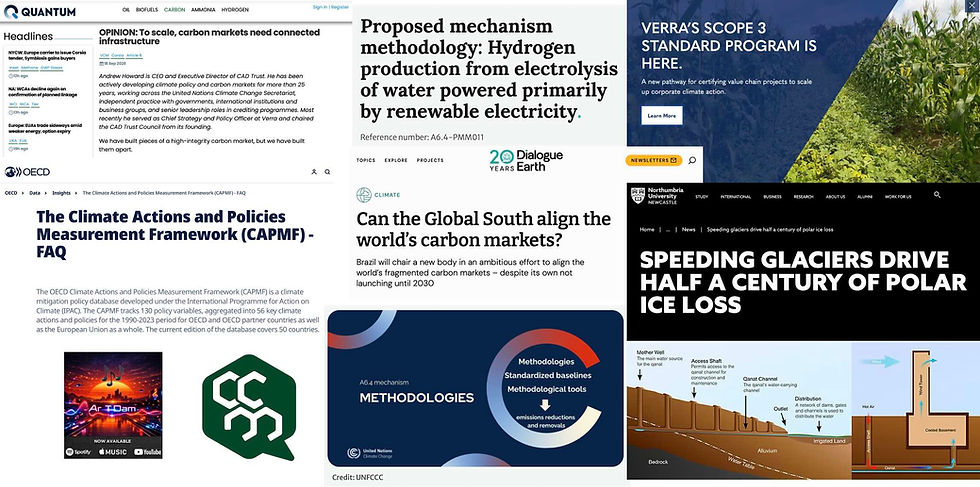
Carbon credits are gaining momentum as Brazil seeks to integrate into global markets and trade with countries like China, while methodologies under Article 6.4 of the Paris Agreement continue to evolve. In parallel, Verra has launched a Scope 3 standard, expanding the certification of reductions within value chains and their connection to carbon markets.
Other highlights include the new OECD tool that monitors and compares climate mitigation policies across 50 countries, taking into account their adoption and level of stringency. Meanwhile, a study on Greenland and Antarctica indicates a loss of 11.3 trillion tons of ice between 1979 and 2023, contributing to a 3.14 cm rise in global sea levels.
Briefs and opportunities include a public consultation on the methodology for carbon credits linked to hydrogen production via electrolysis using renewable electricity, under Article 6.4 with submissions accepted until October 1, 2026. Also drawing attention are the need for interconnected infrastructure to expand carbon markets and the revival of qanats, an ancient technique adopted in Seville as an example of urban adaptation.
In addition to a list of relevant events.
Carbon Credits
Does Brazil aim to lead the integration of carbon markets even before its own market launches?
Dialogue Earth recently raised a provocative question: how can Brazil spearhead the alignment of global carbon markets when its own regulated system is still being designed and trading is not expected to begin until 2030? Spearheading the Open Coalition on Compliance Carbon Markets (OCCCM), the country seeks to harmonize standards for monitoring, accounting, and integrity, reconciling the priorities of the Global South with systems already established in developed economies. The initiative gained momentum at the China Carbon Market Conference in Wuhan, as Brazil explores the possibility of China purchasing Brazilian credits, with the ambition of reaching a bilateral agreement by COP31 in November. In parallel, the Paris Agreement’s Article 6.4 mechanism is advancing methodologies for various forms of emission reduction and removal, including activities such as industrial N₂O abatement, landfill gas utilization, and renewable energy generation, thereby intensifying the debate over which technologies and solutions will generate credits and who will capture value in these new carbon markets.
Verra launches standard for Scope 3 emissions and expands link to carbon credits
On September 15, Verra launched its Scope 3 Standard (S3S) Program, an independent framework for quantifying, verifying, and certifying emission reductions and removals within corporate value chains. The program will enable the generation of Scope 3 Units (S3Us), each corresponding to one tonne of CO₂ equivalent reduced or removed within the value chain, and will operate alongside the Verified Carbon Standard (VCS). This allows projects to potentially issue either S3Us or traditional carbon credits, thereby expanding their financing options and the pool of potential buyers. Initially, Version 1 covers methodologies adapted from the VCS for improved agricultural land management and low-carbon concrete production, with plans to expand into other sectors; future updates are expected to enable project registration, validation, and verification, as well as the initial issuance of the units.
Others Highlights
OECD tool monitors climate policies across 50 countries
A few months ago, the OECD released the Climate Actions and Policies Measurement Framework (CAPMF), a harmonized international database created under the International Programme for Action on Climate (IPAC) to track the evolution of climate mitigation policies. The system compiles 130 variables, aggregated into 56 actions and policies, covering 50 countries from 1990 to 2023. It considers both policy adoption and the degree of policy stringency, defined by the capacity of government measures to mandate, incentivize, or enable the reduction of greenhouse gas emissions. According to the OECD, the framework’s key advantage is that it provides consistent, coherent climate data validated by the countries themselves; this allows for the comparison of policy instruments and sectors, the monitoring of policy strengthening over time, and the establishment of a basis for analysis, though the stringency indicators are intended for informational purposes and should not be interpreted as measures of policy performance or effectiveness.
Over nearly half a century, ice loss in Greenland and Antarctica has raised global sea levels by 3.14 cm.
Published on September 16, a groundbreaking study based on the longest satellite imagery record ever compiled reveals that Greenland and Antarctica lost 11.3 trillion tons of ice between 1979 and 2023. This contributed to a 31.4 millimeter rise in global sea levels. Most notably, 84% of this loss was driven by accelerating glacier retreat and the resulting discharge of ice into the ocean, while the remaining 16% stemmed from surface melting. Losses have surged since the 1990s, and despite occasional periods of temporary slowdown, scientists state that these do not represent a reversal of the long-term trend. The study synthesized 42 independent assessments from 27 satellite missions and was published in the journal Scientific Data. The findings were released by Northumbria University, which led the evaluation alongside researchers from the University of Washington Applied Physics Laboratory.
Briefs & Opportunities
Carbon credits. Public consultation open on the proposed methodology for hydrogen production via water electrolysis, powered primarily by renewable electricity, under Article 6.4 of the Paris Agreement. Submissions accepted until October 1, 2026.
Carbon markets need connected infrastructure to scale up: in an opinion piece, Andrew Howard, CEO of CAD Trust, highlights that carbon credit registries, government programs, and reporting frameworks have developed in a fragmented manner, thereby constraining climate finance and argues that connecting them requires a collaborative effort.
With temperatures steadily rising, some modern cities are rediscovering a technique that dates back about a thousand years. In Seville, Spain, the solution lies in reviving qanats, a historic underground system. This topic is drawing attention precisely because it bridges ancient knowledge and contemporary climate challenges, demonstrating how ideas from the past can once again take center stage in discussions on urban adaptation. It is well worth exploring this ancient technique and understanding why it has sparked renewed interest in the twenty-first century.
Events
September
🇮🇳 28, India Forum: Advancing International Carbon Markets for Climate Ambition, Sustainable Development and Shared Prosperity. Delhi, India.
🇯🇵 30, Building Resilient and Sustainable Cities amid Climate Change and Water Challenges. ISAP 2026, International Forum dor Sustainable Asia and the Pacific
October
🇦🇿🇺🇳 5 - 9, UNFCCC Climate Week 2, Baku, Azerbaijan.
🇫🇷 7 - 8, OECD Forum on Green Finance and Investment. In Paris or online.
📅 07 - 08, Congress SAE BRASIL 2026, Pavilhão da Bienal – Parque Ibirapuera, São Paulo, Brazil
🇦🇺 20 - 21, Australasian Emission Reduction Summit, Adelaide, Australia
November
🇹🇷 9 - 20, COP31. Antalya, Türkiye.
Carbon Credit Markets is an educational channel and leading media outlet in the carbon markets with a strong digital presence and a global audience in over 100 countries.