.jpg)


24th week CCM 2026. Week of convergences. Methodologies Article 6; EU Sectoral ETS; Territorial accounting; OECD Natural Resources; EU Forests; COP30–31 and Agriculture; ESG CEOs; IPCC Cities; Culture
- Art Dam
- Jun 14
- 6 min read
Monday, 15 June 2026.
24th Week Carbon Credit Markets in 2026.
If you like - listening to this French emotional rap, Carbone qui Monte or others at your choice.
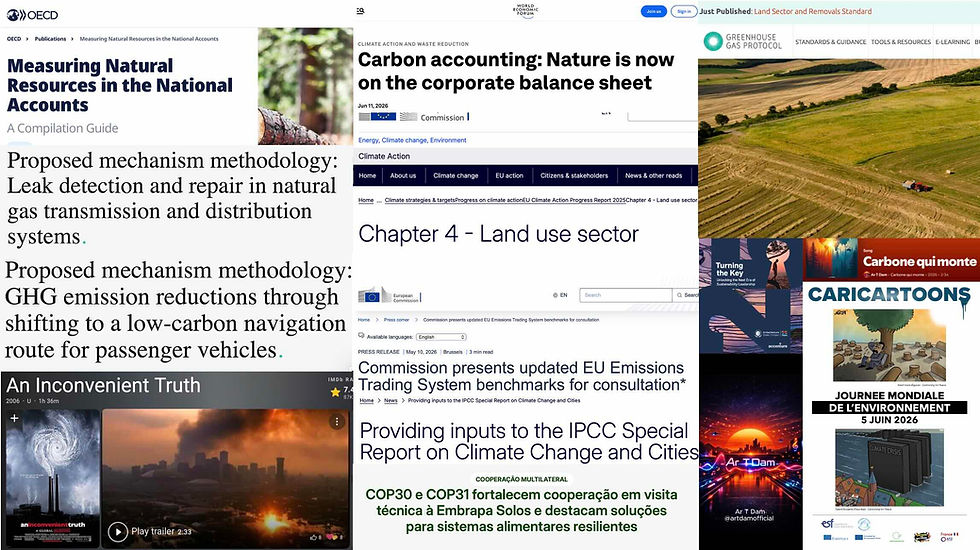
Carbon markets are moving forward with the regulation of Article 6.4, which revises energy efficiency methodologies in cookstoves and renewables, as well as opening a public consultation for new low-carbon navigation approaches and leak detection. At the same time, the European Commission updated the EU ETS benchmarks for 2026–2030, gradually adjusting reference values for sectors such as cement, refining, steel, paper, chemicals and fertilizers, in an effort to reduce emissions.
Other highlights show recent progress aligning climate, nature, and land use across the entire industry—not just agribusiness: the new GHG Protocol Land Sector & Removals introduces the concept of property carbon potential; the OECD standardizes the measurement of natural resources in national accounts; the EU warns of declining forest absorption capacity; and COP30–COP31 strengthen cooperation on sustainable agriculture and resilient food systems.
Shorts & Opportunities highlight business trends that reinforce pragmatism and convergence between climate, cities, and corporate sustainability: the UN Global Compact–Accenture study shows CEOs more focused on concrete ESG results; the IPCC opened contributions to the draft report on climate and cities; two decades after An Inconvenient Truth, Al Gore's climate warning remains relevant; and Cartooning for Peace highlighted the power of art and humor to communicate environmental issues, in line with our cultural initiatives linked to carbon markets.
In addition to a list of relevant events.
Carbon Credits
UN advances regulation of Article 6 and the carbon credit market with new methodologies under consultation until June 25
The Methodological Expert Panel (MEP) of Article 6.4 of the Paris Agreement will hold its 14th meeting between June 22 and 26, 2026, in Bonn, to advance the definition of the rules that will guide the future of carbon credits under the UN mechanism. The annotated agenda of the — includes the analysis of methodological drafts for “energy efficiency measures in domestic cooking” and “electricity generation from renewable sources connected to electrical systems”.
In parallel, the UNFCCC opened a public consultation on two proposed methodologies for the Article 6.4 mechanism, with a deadline for contributions until June 25, 2026. The proposals address:
These consultations represent a central step in Consolidation of the rules of the global carbon credit market under Article 6.4, allowing governments, companies and experts to contribute directly to the design of methodologies that will define the environmental integrity and credibility of the mechanism.
European Commission Updates EU ETS Benchmarks for 2026–2030
The European Commission has presented the new EU ETS benchmarks for 2026–2030, now open for public consultation until June 8, 2026, reinforcing that these reference values — fundamental for calculating the allocation of free allowances, which will continue to cover an average of 75% of industrial emissions — have been updated to reflect greater efficiency and maintain the inclusion of indirect electricity emissions in 14 sectors, with an estimated financial impact of €4 billion. With the new benchmarks, sectors such as cement, refining, steel and paper will face stricter emission limits, which gradually reduces the amount of free allowances (without eliminating them) and puts pressure on European industry to accelerate decarbonization.
Others Highlights
New global standard encourages companies to measure not only emissions, but also the carbon potential of their properties
“How much did you emit this year?” was the central question of advanced corporate climate accounting — and now a second crucial question arises: “How much carbon could your company’s land be storing, relative to its native ecosystem potential?”
The World Economic Forum article, published ahead of the Annual Meeting of the New Champions (“Summer Davos”) in June 2026 in China, highlights that the new GHG Protocol Land Sector and Removals Standard (2026) transforms this system by requiring companies to report not only their emissions and removals, but also the potential carbon stock that their lands could retain if restored to their native ecosystem, introducing the concept of carbon opportunity cost and creating a true “carbon balance sheet”. This change exposes previously invisible impacts of agriculture, land-use change, and supply chains, pressuring companies, governments, and investors to reassess subsidies, future productivity, asset risks, and ecological restoration strategies, by integrating climate, food, and biodiversity into a single accounting logic.
Although the new protocol applies to all companies that own land, forests, agriculture, livestock, management, biofuels or land-dependent supply chains, both the GHG Protocol and the WEF make it clear that the agricultural sector (agriculture, forestry and land use) will be the most profoundly transformed, as it concentrates the largest share of emissions and land-based carbon storage potential.
OECD Launches Guide to Standardize Measurement of Natural Resources in National Accounts
The report “Measuring Natural Resources in the National Accounts – A Compilation Guide”, published by the OECD, offers practical guidance for countries to integrate natural resources — such as water, forests, minerals, and energy — into national accounts, aligning with the System of Environmental-Economic Accounting (SEEA). The guide highlights the importance of standardized methods, consistent data, and international harmonization to improve the measurement of stocks, flows, environmental degradation, and economic use of resources, strengthening public policies, comparability between countries, and analyses of sustainability, productivity, and long-term growth.
European Union warns of declining capacity of forests to absorb carbon and risk to 2030 climate targets
The Land Use and Forests (LULUCF) chapter of the EU Climate Action Progress Report 2025 shows that Europe's capacity to absorb carbon continues to decline, despite a slight improvement to -198 MtCO₂e in 2023, leaving a deficit of 40–55 MtCO₂e to meet the 2030 target. EU forests are absorbing less carbon than a decade ago, pressured by droughts, fires, pests and increased harvesting intensity, and the report reinforces the urgency of more investment and better monitoring to recover this essential function.
COP30 and COP31 Expand Cooperation on Sustainable Agriculture
The technical visit to Embrapa Solos brought together representatives from COP30 and COP31 to strengthen international cooperation around resilient food systems, focusing on innovation, climate adaptation, and the implementation of solutions at scale. The meeting highlighted initiatives such as AgriZone – a Brazilian innovation at COP30 – the Solutions Acceleration Plans, and integrated actions between science, territorial knowledge, public policies, and financing, reinforcing the role of the COPs as mobilization platforms to transform agriculture and expand results towards Antalya.
Shorts & Opportunities
The UN Global Compact–Accenture study, “Turning the Key: Unlocking the Next Era of Sustainability Leadership” reveals that sustainability has entered the era of pragmatism, with 88% of CEOs seeing a stronger business case for ESG, although only 35% of the SDGs are on track. This global diagnosis exposes the real advances, tensions, and priorities of corporate leadership—it's worth reading to understand where global businesses are heading.
With the Special Report on Climate Change and Cities scheduled for March 2027, the IPCC is accepting comments on the Second Order Draft (SOD) until June 19 — a unique opportunity to influence an important scientific document and contribute evidence, urban experiences, and concrete proposals to strengthen the global response to warming.
Twenty years after the global impact of "An Inconvenient Truth," when Al Gore highlighted the powerful combination of science, truth, and the economic weight of clean energy — reminding us that "nothing is scarier than the truth"—this is a warning that shaped the world. It's worth watching again one of the most influential documentaries in history.
Celebrating World Environment Day, last June 5th, the project — based on two socially conscious cartoons by Sherif Arafa (Egypt) and Tjeerd Royaards (Netherlands), members of Cartooning for Peace — shows how humor, satire, and the power of images allow environmental issues to be addressed in a direct, accessible, and universal way. A powerful combination of art and awareness — similar to what the artist Ar T Dam does through music for Carbon Credit Markets. Watch the two videos on YouTube by clicking on the cartoonists' names.
Events
June
🇬🇧 20-28, London Climate Action Week 2026.
July
🇫🇷 1–2, Green Growth and Sustainable Development (GGSD) Forum 2026. In Paris and online.
🇯🇵 22, Strengthening Local Resilience to Planetary Crises: Scaling up Synergistic Solutions. Kobe, Japan, in-person and online.
🇧🇷 24, 2nd Brazilian Conference on Greenhouse Gas Inventory. Curitiba, Brazil.
August
🇧🇷 27 - 28, Brazilian Climate and Carbon Conference, Brazil NBS Alliance.
September
🇨🇳15, Carbon Market Conference. Open Coalition on Compliance Carbon Market, in Wuhan, China.
October
🇦🇿🇺🇳 5 - 9, UNFCCC Climate Week 2, Baku, Azerbaijan.
📅 October 07 & 08, Congress SAE BRASIL 2026, Pavilhão da Bienal – Parque Ibirapuera, São Paulo, Brazil
🇦🇺 October 20-21, Australasian Emission Reduction Summit, Adelaide, Australia
📅 October 28, Verra’s October 2026 Stakeholder Update Webinar
Carbon Credit Markets is an educational channel and leading media outlet in the carbon markets with a strong digital presence and a global audience in over 100 countries.