.jpg)


18th Week CCM 2026. World Bank and carbon credit markets; ISO standardization; Africa and COP32; Japan and GX-ETS; Article 6; Colombia, the Netherlands, and fossil fuels; coherence in the EU and more
Monday, 04 May 2026.
18th Week Carbon Credit Markets in 2026.
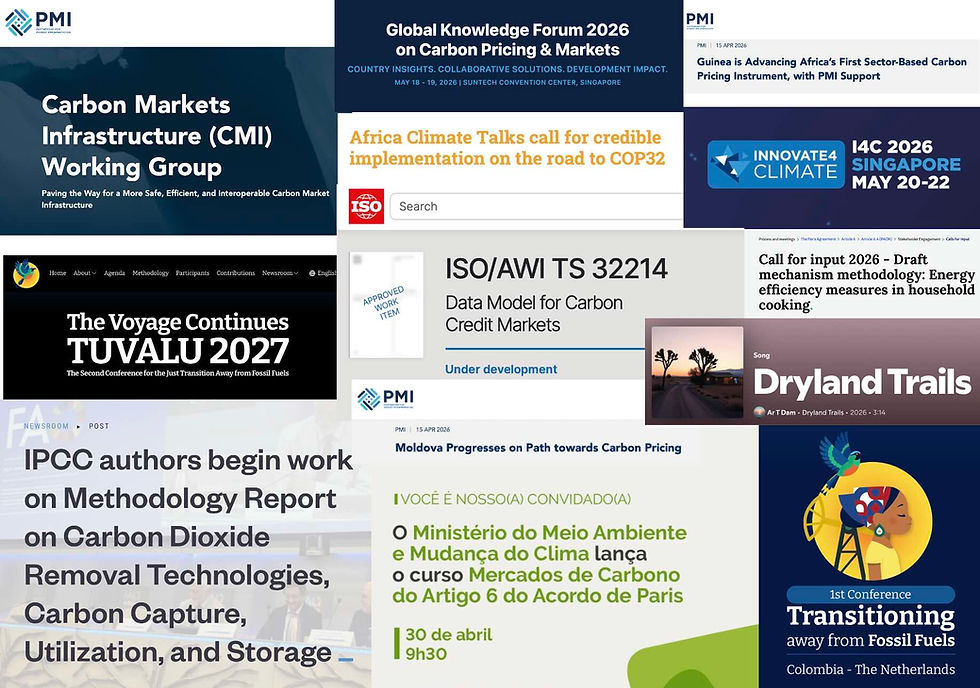
Carbon markets are advancing globally, with the World Bank supporting new instruments in countries such as Guinea and Moldova, while ISO develops a unified standard for carbon credit data. Africa underscores the need for climate implementation and greater market participation ahead of COP32, and Japan finalizes its mandatory GX‑ETS, which will cover 60% of national emissions. Under Article 6, the MEP has opened early public consultations on methodologies and technical recommendations that will inform Supervisory Body decisions in May 2026.
Other highlights include the pioneering conference on energy transition in Santa Marta, Colombia, organized with support from the Netherlands, where more than 50 countries discussed reducing fossil fuels in a just, orderly and equitable manner, coordinated by Activation Group 4 and with the next edition already scheduled for Tuvalu. In parallel, the European Union stated that accelerating the transition and reducing fossil dependence is central to its strategic autonomy, calling for greater coherence between words and action.
Shorts & Opportunities include the launch in Brazil of a free course on Article 6 carbon markets; the opening by GGGI of an international call for research on carbon finance with adaptation benefits; the start by the IPCC of a new methodological report on CO₂ removal and capture; the publication by the IFRS Foundation of the revised Due Process Handbook; and new opportunities from Economist Enterprise for organizations interested in COP31 in Turkey.
And a list of unmissable events.
More details below and - if you like - listening to the country ballad “Dryland Trails” or some other musical choice of your preference.
Carbon Credits
World Bank advances significantly in carbon pricing and market infrastructure
Busy times with the arrival of the World Bank’s new Global Director for Climate. His group, the Partnership for Market Implementation (PMI), highlights that more than 35 countries are advancing in carbon pricing, with the following recent developments:
Guinea moves forward to implement Africa’s first sectoral carbon pricing instrument, starting with the bauxite and iron ore sectors, with an intensity‑based model, early phases of data collection and capacity building, and the creation of a Carbon Unit within the Ministry of Environment to coordinate implementation.
Moldova brought its Climate Action Law into force in January 2026, creating the legal basis for carbon pricing and an EU‑aligned MRV system, with PMI support in impact analysis, exposure to the CBAM, defining an implementation roadmap, and advancing the framework for a future carbon tax.
In addition, technical groups such as the Carbon Market Infrastructure Working Group are developing guidance for scalable systems, while results will converge in meetings in Singapore this May during Innovate4Climate and the Global Knowledge Forum on Carbon Pricing and Markets.
ISO advances in global standard to harmonize carbon credit data
The ISO/AWI TS 32214 standard, currently under development in the ISO/TC 322 – Sustainable Finance committee, proposes creating a unified data model to identify and describe carbon credit projects and units, harmonizing taxonomies, fields, and formats across different registries and preparing them for use in financial markets, as indicated by ISO. In parallel, the Climate Action Data Trust reports that experts gathered in Guangzhou in October 2025 began drafting the technical specification, which is expected to be completed in 2027, integrating initiatives such as the Common Carbon Credit Data Model and the Carbon Data Open Protocol, strengthening international cooperation to standardize data and increase trust in carbon markets.
Africa Advocates Climate Implementation and Expansion of Carbon Markets toward COP32
The Africa Climate Talks — a continental forum organized by the Economic Commission for Africa (UNECA) to bring together experts, governments, civil society, and the private sector in shaping Africa’s positions for the COPs — highlighted that Africa needs to move from commitments to implementation, despite emitting less than 4% of global greenhouse gases and receiving only 11% of the financing required to meet its NDCs, estimated at US$ 277 billion annually. Its Executive Secretary stated that COP32 must be a credibility test, focusing on climate finance, adaptation, integrating climate action into development, and strengthening African influence in negotiations. The meeting also strongly emphasized carbon markets, advocating for greater African participation and their strategic potential to drive structural transformation, green industrialization, and new sources of climate revenue for the continent.
Japan formalizes the final design of its mandatory carbon market
The METI document consolidates the technical design of the new national emissions trading system (GX‑ETS), which will become mandatory in 2026 for companies with more than 100,000 tons of direct CO₂ emissions, requiring them to prepare transition plans, calculate and verify emissions annually, and hold credits equivalent to the volume emitted. The system combines sectoral benchmarks and grandfathering — a method that allocates carbon allowances based on a company’s historical emissions, gradually reducing that volume over time — for allowance allocation, establishes minimum and maximum prices for stability, allows limited use of J‑Credit and JCM credits, and will be operated by the GX Acceleration Agency (GX推進機構), creating a regulated market that covers about 60% of Japan’s emissions and inaugurates the full phase of the GX‑ETS.
Public consultations under Article 6 advance toward decisions in May 2026
The Methodological Expert Panel (MEP) concluded its 13th meeting in Bonn and opened new public consultations to inform the 21st meeting of the Article 6.4 Supervisory Body, scheduled for 18–21 May 2026. Among the calls, a highlight is the consultation on the draft methodology for energy efficiency in household cookstoves, open from 24 April to 15 May 2026, whose contributions will be assessed by the MEP at its next meeting, from 22 to 26 June 2026. In parallel, until 6 May 2026, stakeholders may submit comments on the MEP recommendations, which include the lock‑in risk assessment tool, the additionality demonstration standard, the tool for the fraction of non‑renewable biomass, and the methodology for N₂O abatement in nitric acid production. The early opening of these consultations expands the time available for stakeholders to contribute before the Supervisory Body’s deliberations.
Others Highlights
Pioneering Conference Drives Global Cooperation for the Fossil Fuel Transition
The meeting inaugurates a new type of international dialogue — less tied to formal UN negotiations and more focused on practical solutions — bringing together about 60 countries that represent one‑third of global oil consumption and one‑third of global GDP, creating a rare space for cooperation on the real challenges of the transition.
The first international conference focused exclusively on reducing dependence on fossil fuels, held in Santa Marta (Colombia) with support from the Netherlands and participation from more than 50 countries, advanced the conversion of the COP28 commitment into national plans and mechanisms for ongoing coordination. As detailed in the official document of the co‑hosts, the meeting reinforced the need for a just, orderly and equitable transition. Aiming to ensure year‑round progress, it also consolidated alignment with the corresponding Activation Group — specifically AG4: Transitioning away from fossil fuels in a just, orderly and equitable manner. The text further highlights the importance of international cooperation, early planning, and support for countries dependent on fossil fuels to enable the effective implementation of the global agenda for the gradual reduction of these fuels.
The next conference is already scheduled and will take place in 2027… “Far from the grand cities of the American giant. And the ancient castles and splendor of Europe. There lies a vast blue continent. More ocean than land, more tide than border. More memory than monument. Far from places that have long help power. From structures that have steered us deeper into the storm. Stands a lighthouse for humankind. Here the horizon is not an end, but a premise … Tuvalu …” in the Pacific Ocean. Details and video here.
EU Strengthens Climate and Energy Diplomacy with a Focus on Strategic Autonomy
The conclusions of the European Union Foreign Affairs Council, adopted on 29 April 2026, on energy and climate diplomacy state that strengthening international engagement is essential for the bloc’s sovereignty, emphasizing that accelerating the energy transition and reducing dependence on fossil fuels is the most effective path to strategic autonomy. The document — approved by the body that brings together the EU Foreign Ministers and defines the common foreign policy — also adopts a multi‑annual approach to diplomatic priorities, reaffirms the value of multilateralism, and acknowledges that, amid geopolitical tensions and global impacts — such as the rising cost of LNG affecting more vulnerable countries — the EU needs to demonstrate greater cooperation and coherence between words and action.
Shorts & Opportunities
Carbon Markets under Article 6 of the Paris Agreement. A free course has been launched in Brazil, updated through August 2025, offering technical, legal, and strategic training on international cooperation for emission reductions. It covers Articles 6.2 and 6.4, ITMOs, MCUs, carbon credits, international experiences, and applications in public policy and in the Brazilian NDC. This is a 15-hour course, certified by ENAP and developed by MMA. Open to anyone interested in the topic.
With a deadline of 19 May 2026, the Global Green Growth Institute (GGGI) — an intergovernmental international organization created and funded by national governments to support developing countries in the transition to a green economy — has opened a call for research on carbon finance with adaptation benefits, inviting experts to explore how vulnerable countries can participate in carbon markets with integrity.
CO₂ removal, carbon capture, use and storage was the theme of the new methodological report initiated on 14 April 2026 by the IPCC, the UN scientific panel composed of more than 150 experts.
The IFRS Foundation — the entity that oversees global financial reporting standards — published on 30 April 2026 the revised version of the Due Process Handbook, strengthening the governance of international sustainability, climate, and financial information standards developed by the ISSB, the body responsible for global climate‑disclosure norms.
The Economist Enterprise is opening opportunities for organizations that wish to lead the COP31 conversations, in November, in Turkey — read the full material and learn more about it.
Events
🇬🇧 May 7, An overview of proposed enhancements to three SASB Standards. IFRS Sustainability Alliance.
🇨🇭May 12, Building Credible Strategies for Carbon Dioxide Removals. Gold Standard
🇧🇷 May 13-14, Fórum CCS Brasil. British Consulate-General São Paulo, Brazil.
🇦🇺 May 20 - 21, Carbon Farming Industry Forum 2026. Freemantle, Australia
🇸🇬 May 20 – 22, Innovate4Climate (I4C) 2026. In Singapore
🇪🇸 May 21 - 22, 13th Meeting of the Roundtable on Financing Water. OECD, Bank of Spain (Banco de España), CDP and the Network for Greening the Financial System (NGFS)
🇵🇪 May 27 - 28, Peru Carbon Forum 2026, 3ra edición, ESAN, Lima, Peru
🇧🇷 July 24, 2nd Brazilian Conference on Greenhouse Gas Inventory. Curitiba, Brazil.
🇧🇷 August 27 - 28, Brazilian Climate and Carbon Conference, Brazil NBS Alliance
🇦🇿🇺🇳 October 5 - 9, UNFCCC Climate Week 2, Baku, Azerbaijan
Carbon Credit Markets is an educational channel and leading media outlet in the carbon markets, member of the coalition COP Experience, with a strong digital presence and a global audience in over 100 countries.