.jpg)


20th Week CCM 2026. UNFCCC registries; auction‑based pricing; CBAM review; SBCE; Turkey–Iraq oil-for-water; Mexico City subsidence; Carbon Pricing 2026, COP31, Paraguay, GHG Protocol, ECB job
Monday, 18 May 2026.
20th Week Carbon Credit Markets in 2026.
If you like - listening to “Hydrogen Comes Strong” or others at your choice.
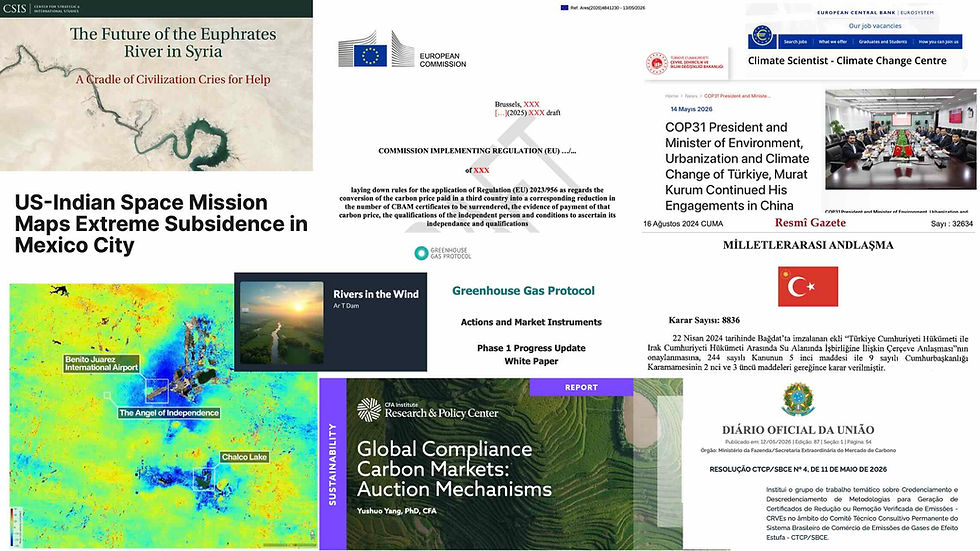
Carbon credits. The global landscape is advancing with the UNFCCC’s presentation of the Article 6.2 and 6.4 registry systems, the CFA Institute’s publication of an analysis on carbon‑price formation in regulated auctions, the EU’s public consultation on proposed CBAM adjustments to recognize carbon credit prices paid outside the bloc, and new regulations defining the governance and technical committees of Brazil’s Emissions Trading System.
As other highlights today we addressed water. Extreme drought in the Tigris–Euphrates basin led Turkey and Iraq to establish an unprecedented oil‑for‑water agreement, while scientific evidence shows that the water crisis is already causing drastic drops in river levels, displacement, and systemic failures. In parallel, satellite images reveal accelerated subsidence in Mexico City, compromising infrastructure and water supply and reinforcing the urgency of monitoring and adaptation in the face of worsening water‑related risks.
Shorts & Opportunities: the scenario brings together relevant releases and calls — the World Bank will present the State and Trends of Carbon Pricing 2026 report at Innovate4Climate, while COP31 highlighted new engagements by Turkey in China for cooperation on climate and infrastructure; Paraguay has opened a strategic consultancy linked to Article 6, the GHG Protocol is receiving contributions for the RFI on Actions and Market Instruments until 31 May, and the European Central Bank has posted a vacancy for a climate and environmental‑risk specialist, with applications open until 3 June 2026.
And a long list of unmissable events.
Carbon Credits
UNFCCC Presents Details of the Article 6.2 and 6.4 Registries under the Paris Agreement
In two technical webinars held by the UNFCCC last week, in which CarbonCreditMarkets participated, the MVPs (Minimum Viable Products) of the new registries established under Articles 6.2 and 6.4 — which will form the backbone of the global carbon‑market infrastructure under the Paris Agreement — were presented.
The content on Article 6.2 detailed the MVP of the International Registry and the Additional Registry Services (ARS), which will enable the issuance, transfer, and cancellation of ITMOs (Internationally Transferred Mitigation Outcomes), MOs (Mitigation Outcomes), and AMOs (Authorized Mitigation Outcomes for international use). “Countries/parties… may engage… in cooperative approaches that involve the use of ‘internationally transferred mitigation outcomes’ (ITMOs)” and in this sense, the UNFCCC secretariat was tasked with providing ready‑to‑use infrastructure for countries without national registries, including essential processes — issuance, authorizations, transfers, and cancellations.
In the webinar dedicated to Article 6.4, the MVP of the Paris Agreement Credit Mechanism (PACM) Registry was presented. The mechanism introduces A6.4ERs, which may be authorized for international use as ITMOs, and MCUs, intended for domestic and voluntary use. The registry will track the entire lifecycle of units — “from issuance through authorization, transfer, acquisition, use, and cancellation” — ensuring full traceability, transparency, and structural prevention of double counting. The system was “designed from the ground up around NDCs”, incorporating environmental and social safeguards, validation by DOEs (Designated Operational Entities) — independent bodies accredited by the UNFCCC to conduct technical audits of mitigation projects and programs — and direct oversight by the regulatory body.
Both registries are expected to reach final implementation in the fourth quarter of 2026, following the testing, adjustment, and integration phase between the mechanisms.
How are carbon prices formed? CFA Institute analysis reveals the mechanisms
The newly released report Global Compliance Carbon Markets: Auction Mechanisms, by Yushuo Yang, PhD, CFA, published by the CFA Institute Research and Policy Center — a global organization dedicated to raising professional standards in finance through research, education, ethics, and the CFA (Chartered Financial Analyst) certification — shows that the allocation of carbon allowances is decisive for price formation, which occurs in auctions based on the interaction between the regulated supply of allowances, companies’ demand, and the auction’s own rules, factors that determine the final value paid for carbon units; the study analyzes the transition from free allocation to auction‑based models and compares the structures adopted in the European Union, California, and the United Kingdom, also assessing price stability, demand depth, and auction performance, and identifying the elements that explain their effectiveness, while offering a practical framework for investors and policymakers to evaluate opportunities in primary carbon markets.
European Union seeks to adjust CBAM rules to recognize carbon prices paid outside Europe
The new CBAM implementing regulation deepens how importers will be able to demonstrate the carbon price already paid in third countries, convert it into euros, and deduct it from the number of CBAM certificates to be surrendered. The text details criteria for accepted evidence, limits for compensations and rebates, the use of default prices defined by the Commission, and strict requirements for the “independent person” responsible for certifying the data — including accreditation, verification, independence, and access‑to‑primary‑information standards. The proposal — whose draft is available below — also clarifies the treatment of carbon credits, domestic taxes, foreign ETSs, precursors, indirect emissions, and situations in which part of the emissions is exempt or compensated, always with the aim of ensuring, as the document states, that “a carbon price is not paid twice on the same emissions”. The proposal is open for contributions until June 10, offering an opportunity for companies, experts, and citizens to influence the final version of the rules that will define how the EU will recognize carbon prices paid outside the bloc — and, therefore, how the CBAM will function in practice for international trade.
New resolutions strengthen the structure of Brazil’s regulated carbon market
Published on May 11, 2026, four Resolutions of the Permanent Technical Advisory Committee (CTCP) advance the consolidation of the Brazilian Emissions Trading System (SBCE) by defining its governance and creating technical groups responsible for financial, methodological, and monitoring‑related topics. The regulations establish the operational basis for the functioning of the regulated carbon market and expand the Committee’s technical capacity.
Internal Rules of the Permanent Technical Advisory Committee, responsible for recommendations for the improvement, implementation, and functioning of the SBCE (CTCP/SBCE Resolution No. 1/2026)
Financial Aspects Working Group, tasked with analyzing financial instruments, market mechanisms, and risk management associated with SBCE assets (CTCP/SBCE Resolution No. 2/2026)
MRV Working Group, dedicated to technical requirements for emissions monitoring and criteria for accreditation and supervision of independent verifiers (CTCP/SBCE Resolution No. 3/2026)
Methodologies Working Group, responsible for criteria for accreditation and de‑accreditation of methodologies for generating CRVEs, as well as requirements for quantifying emission reductions or removals (CTCP/SBCE Resolution No. 4/2026)
Others Highlights
Trading oil for water: the agreement that could redefine the future of the Tigris and Euphrates
The worst drought in nearly a century in the Tigris–Euphrates basin created the conditions for an unprecedented agreement between Turkey and Iraq: trading oil for water. On April 22, 2024, the two countries signed the “Framework Agreement on Cooperation in the Water Field between the Government of the Republic of Turkey and the Government of the Republic of Iraq” — available for download below — which establishes joint water‑infrastructure projects — from the modernization of irrigation systems to the reinforcement of dams — financed by a mechanism based on Turkey’s purchases of Iraqi oil. Implementation took shape on November 2, 2025, when both countries formalized the financial mechanism, as reported by Anadolu Agency (and analyzed by IGFA, consolidating a model of economic interdependence that seeks to confront the severe water crisis and reduce historical tensions between the countries.
This crisis is widely documented: the World Weather Attribution showed that the five‑year drought was worsened by human‑induced climate change, making extreme events “ten times more likely” and leading Iraq to its driest year since 1933. The CSR Journal reported a drop of up to 27% in the Euphrates’ level and warned that the river may dry up by 2040, while the CSIS described agricultural collapse, community displacement, and cholera outbreaks as symptoms of a water system in collapse. In this context, the analysis published on Academia.edu interprets the agreement as an important hydrostrategic step for regional stability — perhaps the last chance to prevent the cradle of civilizations from becoming the epicenter of an irreversible crisis.
Accelerated subsidence threatens water supply: satellite reveals water‑system collapse in Mexico City
With around 20 million inhabitants, the Mexico City region is built over an aquifer whose overexploitation, combined with the weight of urban development, has been compacting the former lakebed for more than a century. Published on April 29, 2026, a NASA article shows that the NISAR satellite, the result of a joint U.S.–India mission, confirmed extreme subsidence, with areas sinking more than 2 centimeters per month, compromising urban infrastructure and water‑supply systems. Images captured between October 2025 and January 2026 reveal accumulated damage — fractures in roads, buildings, and pipelines — in a process that tends to generate massive leaks and may become irreversible in several areas, further worsening the water crisis. The NISAR’s L‑band radar capability to detect subtle ground changes even under clouds, vegetation, or low light makes the mission essential for monitoring environmental risks and growing pressures on water resources.
Shorts & Opportunities
The World Bank’s State and Trends of Carbon Pricing 2026 report — the leading global reference on the evolution of carbon pricing instruments — will be publicly presented at Innovate4Climate this week.
COP31. On May 14, 2026, according to a statement from the COP31 president, progress was made in Turkey’s strategic engagements in China, highlighting meetings with the Silk Road Fund to strengthen cooperation on climate, sustainable infrastructure, and urban resilience.
Paraguay with a focus on carbon markets. The GGGI — an international organization dedicated to supporting countries in the transition to green, resilient, and low‑carbon development — announces a strategic opportunity for qualified companies: proposals are open for the consultancy “Assessment of Mitigation Activities and Development of MAINs (Mitigation Activity Idea Notes)”, part of the project that operationalizes Paraguay’s national carbon market framework and supports its participation in Article 6 of the Paris Agreement. The deadline for submitting proposals is June 1, 2026. Details here.
GHG Protocol. The contribution period for the Request for Information (RFI) on Actions and Market Instruments (AMI) is open until May 31, based on the White Paper that synthesizes the results of Phase 1 of the development of the new standard. The document proposes a GHG reporting framework with multiple statements and presents objectives, definitions, and principles for emissions accounting in AMI, also detailed in the Explanatory Memo. Contributions must be submitted via the official form, and the White Paper does not yet constitute a draft standard — whose public consultation is scheduled for the third quarter of 2027.
European Central Bank (ECB) has opened a position for a climate and environmental risk specialist, seeking someone capable of translating science into economic policies — applications open until June 3, 2026.
Events
🇧🇷 May 18 - 19, Carbon Matters: Voluntary Market and Regulated Market. AMCHAM Brazil's Decarbonization Hub and Netword.
🇺🇸 May 20, Updated Article 6 and CORSIA Label Guidance. Verra webinar.
🇧🇪 May 20-21, Carbon Removals and Carbon Farming “CRCF” Days. European Union Directorate‑General for Climate Action, Brussels.
🇦🇺 May 20 - 21, Carbon Farming Industry Forum 2026. Freemantle, Australia.
🇸🇬 May 20 – 22, Innovate4Climate (I4C) 2026. In Singapore.
🇪🇸 May 21 - 22, 13th Meeting of the Roundtable on Financing Water. OECD, Bank of Spain (Banco de España), CDP and the Network for Greening the Financial System (NGFS)
🇵🇪 May 27 - 28, Peru Carbon Forum 2026, 3ra edición, ESAN, Lima, Peru.
🇧🇷 July 24, 2nd Brazilian Conference on Greenhouse Gas Inventory. Curitiba, Brazil.
🇧🇷 August 27 - 28, Brazilian Climate and Carbon Conference, Brazil NBS Alliance.
🇨🇳September 15, Carbon Market Conference. Open Coalition on Compliance Carbon Market, in Wuhan, China.
🇦🇿🇺🇳 October 5 - 9, UNFCCC Climate Week 2, Baku, Azerbaijan.
Carbon Credit Markets is an educational channel and leading media outlet in the carbon markets with a strong digital presence and a global audience in over 100 countries.